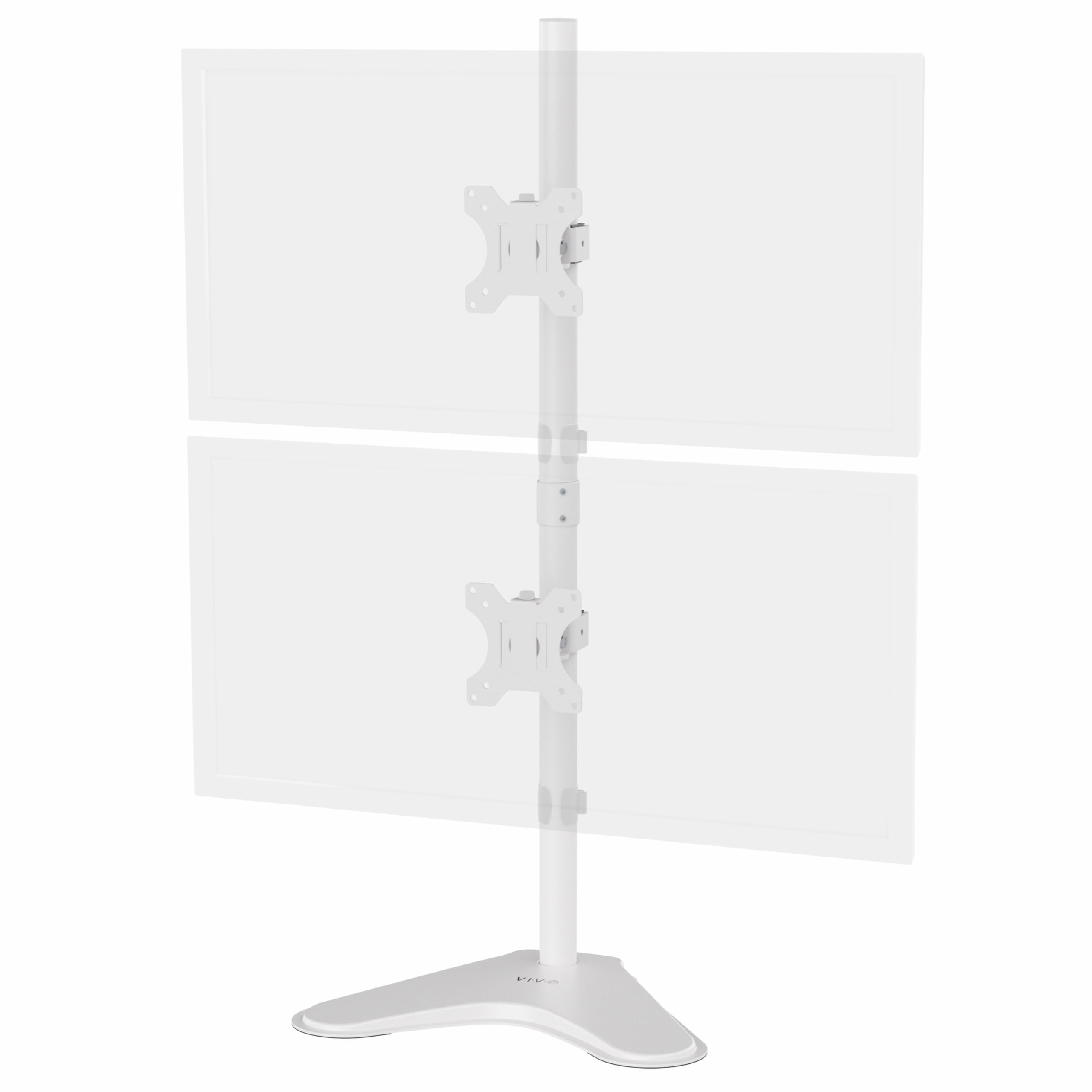
The VIVO STAND-V002LW is a freestanding vertical mount for two monitors, with an emphasis on supporting larger screens without attaching a clamp to the desk edge.
This vivo dual monitor stand review looks at its size range, positioning options, and the desk space its base requires.
VIVO Dual Stand Review Summary
The quick verdict
3,000+ ratings
Read Amazon ReviewsVIVO STAND-V002LW Dual Monitor Stand
A freestanding stacked mount for buyers pairing two VESA-compatible monitors, including ultrawides up to 34 inches, on a desk with room for its broad base.
- Supports two monitors from 13 to 34 inches, with a maximum weight of 22 pounds per screen.
- Fits 75 × 75 mm and 100 × 100 mm VESA mounting patterns.
- Uses a freestanding base measuring 15.4 × 12.4 inches, with padding on its underside.
- Adjustable brackets offer 45-degree upward and downward tilt, 180-degree swivel, and 360-degree rotation.

Pros
- Accommodates two screens up to 34 inches and 22 pounds each.
- Freestanding base avoids relying on a desk-edge clamp.
Consider before buying
- The 15.4 × 12.4-inch base takes up a noticeable part of the desktop.
- Screens are arranged vertically, which may not suit buyers who want side-by-side placement.
Read the full review summary
This stand holds two monitors in a stacked arrangement, each measuring 13 to 34 inches and weighing up to 22 pounds, provided each has a 75 × 75 mm or 100 × 100 mm VESA pattern.
Its wide, padded base makes it a practical option for desks where a clamp is inconvenient or unavailable, while height adjustment along the center pole and adjustable brackets give some flexibility in setting the screens.
Tilt, swivel, and rotation accommodate different viewing angles and portrait or landscape orientation.
The tradeoff is a fixed freestanding footprint: the base measures 15.4 by 12.4 inches, so it takes up desk surface and does not offer the same positioning reach as separate articulated arms.
Check the monitor dimensions, weight, VESA pattern, and available desktop area before choosing it.
The buying factors
VIVO Dual Stand Scorecard
Editorial scores reflect listed features and buyer fit; they are not laboratory measurements or customer ratings.
Screen size and weight range
Supports two 13- to 34-inch monitors, each up to 22 pounds, giving it useful range for a stacked setup.
Viewing adjustments
Tilt, swivel, rotation, and center-pole height adjustment cover the core positioning needs for a vertical pair.
Desk footprint
A substantial padded base avoids a desk-edge clamp but occupies a defined area of the desktop.
Mounting flexibility
The freestanding design suits desks where clamp mounting is impractical, though it still needs a clear, stable surface.
Cable organization
Integrated cable management helps route wires along the stand for a tidier setup.
Assembly convenience
Removable VESA plates and included hardware and instructions are designed to make monitor attachment more manageable.
Key Features and Specifications of VIVO Dual Stand
- Supports two monitors from 13 to 34 inches, with a maximum weight of 22 pounds per screen.
- Fits 75 × 75 mm and 100 × 100 mm VESA mounting patterns.
- Uses a freestanding base measuring 15.4 × 12.4 inches, with padding on its underside.
- Adjustable brackets offer 45-degree upward and downward tilt, 180-degree swivel, and 360-degree rotation.
- Screen height adjusts along the center pole; monitors can be set in portrait or landscape orientation.
- Integrated cable management, removable VESA plates, assembly hardware, instructions, and a three-year warranty are included.
Pros and Cons of VIVO Dual Stand
Pros
- Accommodates two screens up to 34 inches and 22 pounds each.
- Freestanding base avoids relying on a desk-edge clamp.
- Multiple angle adjustments and center-pole height positioning support different viewing preferences.
- Padded base helps protect the desk surface from scratches.
- Removable VESA plates simplify attaching the monitors during assembly.
Consider before buying
- The 15.4 × 12.4-inch base takes up a noticeable part of the desktop.
- Screens are arranged vertically, which may not suit buyers who want side-by-side placement.
- Each monitor needs a compatible VESA pattern and must remain within the stated size and weight limits.
Who Should Buy VIVO Dual Stand?
Good fit
Consider the VIVO STAND-V002LW if you want two monitors stacked vertically and prefer a base that rests on the desktop instead of a clamp attached to its edge.
It is particularly relevant when the screens are larger than the range supported by many compact dual-monitor mounts, as long as each screen fits the stand’s size, weight, and VESA limits.
Before buying, measure a clear place for the base and account for the room needed to position the monitors above it. Confirm both monitors’ VESA hole spacing and weight, including any accessories that remain attached.
The height adjustment runs along the center pole, while bracket tilt, swivel, and rotation let you fine-tune the viewing angle.
The included cable management and removable VESA plates are useful details for setting up a tidy stacked workstation. A three-year warranty also gives the product a defined coverage period.
If those details match your priorities and the base fits your desk, this is a straightforward design to consider.
Who should skip it
Skip this model if you need two screens side by side, want to reclaim nearly all of the desktop beneath the monitors, or need arms that extend independently toward different seating positions.
Look elsewhere if either monitor exceeds 34 inches or 22 pounds, or lacks a 75 × 75 mm or 100 × 100 mm VESA pattern.
If your desk cannot spare the base’s footprint, measure the available surface before settling on a freestanding mount.
How the VIVO Dual Stand Fits a Stacked Setup
A clear use case for larger paired screens
The 34-inch upper size limit makes this stand worth considering for two larger monitors, as long as each remains at or below 22 pounds and uses a supported VESA pattern.
Checking both screens individually matters: a pair can look suitable by size while one display exceeds the weight limit or uses a different mounting pattern.
The base determines where it can go
Because the stand rests on the desktop, placement depends on having a stable, clear surface large enough for its 15.4 × 12.4-inch base.
That layout avoids desk-edge clamping and can work around a desk edge that cannot accept a clamp, but the mount still occupies surface area and fixes the support point to one location.
Adjustment within a vertical arrangement
Height adjustment along the pole helps set the gap and overall position of the stacked screens.
Tilt, swivel, and full rotation provide further angle and orientation choices, but they do not change the basic top-and-bottom layout; consider whether that arrangement fits your tasks and viewing habits.
Setup and cable tidiness
Removable VESA plates let you attach each monitor before placing it on its bracket, while the provided hardware and instructions cover assembly.
Integrated cable management can help keep wires gathered along the mount, though planning cable length around the final screen positions will make routing easier.
Alternatives to VIVO Dual Stand
Computer Monitor Arms alternative
60,000+ ratings
Read Amazon ReviewsVIVO STAND-V038 Dual Ultrawide Monitor Desk Mount
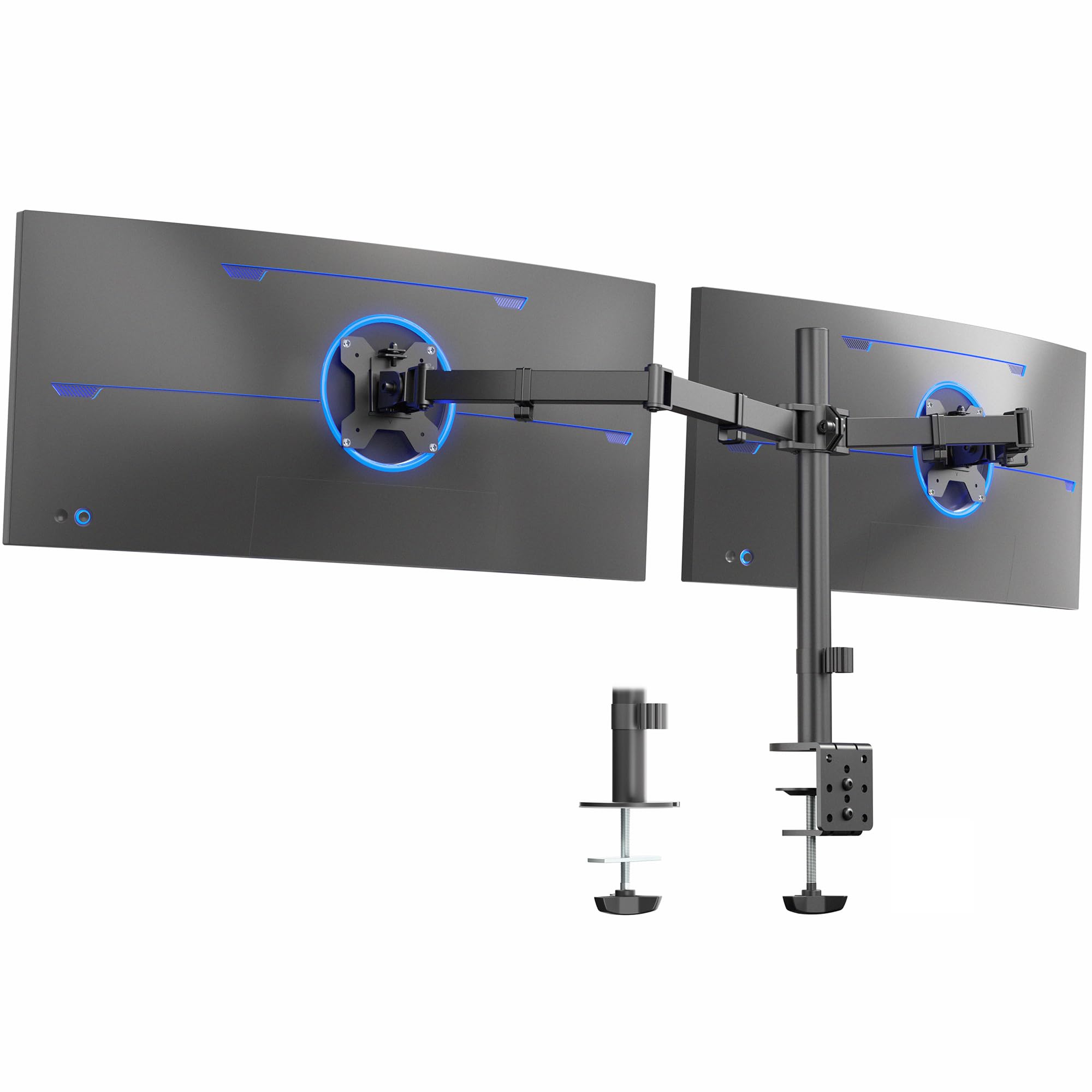
Choose the STAND-V002LW when you want a freestanding base and a stacked arrangement. Consider the STAND-V038 if your monitors are between 34 and 38 inches or you prefer a desk-mounted clamp or grommet setup.
- The STAND-V038 supports two screens up to 38 inches and 22 pounds each, with tilt, swivel, rotation, height adjustment, and either a C-clamp or optional grommet mounting.
- The STAND-V002LW holds two screens up to 34 inches and 22 pounds each in a freestanding vertical arrangement, using a 15.4 × 12.4-inch padded base.
Computer Monitor Arms alternative
10,000+ ratings
Read Amazon ReviewsHUANUO Vertical Dual Monitor Stand
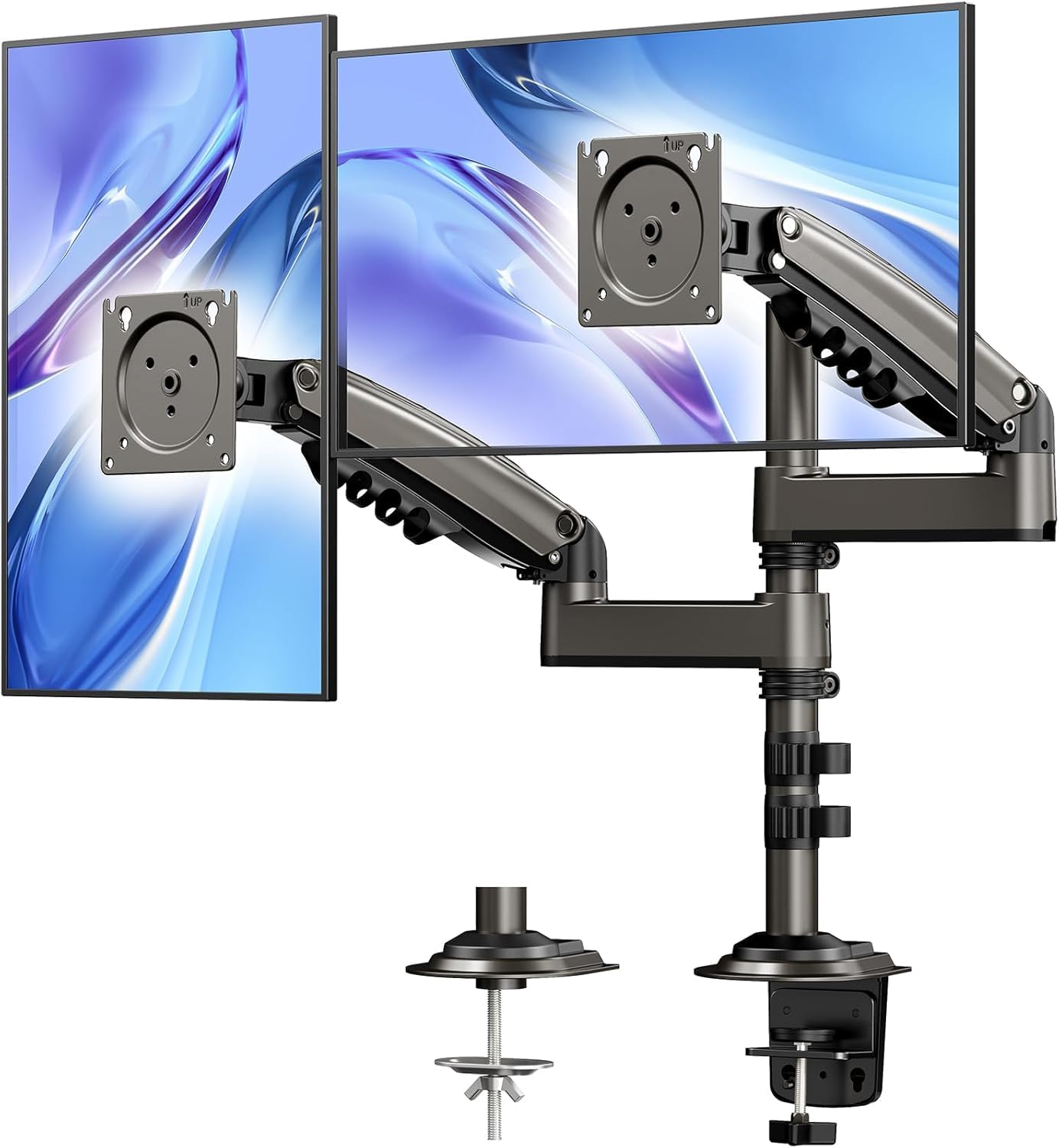
Choose the VIVO for a freestanding base or screens larger than 32 inches, within its limits.
The HUANUO is a better fit if your monitors are within its narrower range and you want a desk-mounted vertical stand with a stated maximum height.
- The HUANUO model supports two 17- to 32-inch monitors weighing 4.4 to 19.8 pounds each, with a 17-inch extension that raises screens up to 25.19 inches and C-clamp or grommet mounting for desks 0.39 to 3.54 inches thick.
- The VIVO supports monitors up to 34 inches and 22 pounds each, with height adjustment along its center pole and a padded freestanding base.
Is VIVO Dual Stand Worth It?
The VIVO STAND-V002LW is worth considering for a two-monitor workstation built around a vertical layout, especially when a desk-edge clamp is not desirable and each display fits its 34-inch, 22-pound, and VESA limits.
Its adjustment options, padded base, cable management, and removable plates make the setup practical to configure.
The main buying decision is whether you can spare the base’s footprint and want the screens stacked.
Measure the desktop and verify both monitors before ordering; if those checks fit your setup, this is a solid candidate for a freestanding dual-monitor stand.
Your review at a glance
3,000+ ratings
Read Amazon ReviewsVIVO STAND-V002LW Dual Monitor Stand
A freestanding stacked mount for buyers pairing two VESA-compatible monitors, including ultrawides up to 34 inches, on a desk with room for its broad base.
- Supports two monitors from 13 to 34 inches, with a maximum weight of 22 pounds per screen.
- Fits 75 × 75 mm and 100 × 100 mm VESA mounting patterns.
- Uses a freestanding base measuring 15.4 × 12.4 inches, with padding on its underside.
- Adjustable brackets offer 45-degree upward and downward tilt, 180-degree swivel, and 360-degree rotation.